Cookie
This website requires cookies to provide all of its features. For more information on what data is contained in the cookies, please see our Privacy Policy page. To accept cookies from this site, please click the Accept button below.
In the ever-evolving landscape of photography and optics, lens resolution stands as a key determinant of image quality. From capturing intricate details to delivering crystal-clear visuals, understanding the nuances of lens resolution is vital for photographers and enthusiasts alike.
Demystifying Lens Resolution:
Lens resolution refers to the ability of a lens to distinguish between fine details and produce sharp, clear images. Measured in line pairs per millimeter (lp/mm), a higher resolution signifies the lens's capability to render intricate details, making it a critical consideration for photographers aiming for precision in their shots.
Resolution (or resolving power) is the ability of the lens to register tiny details separately. The resolution is measured in lines per mm that can be distinguished on the negative film. This resolution definition ties lens properties with some film quality parameters, so it describes rather not the lens alone, but the lens/film system.
For cine and still image lenses, this approach provides results most close to real life. The possibility to compare the resolution of different lenses is provided by special film types, constant exposures and the same developing processes. Resolution is measured by shooting of transparent test charts with test images in the center and at frame field. A special camera is used to provide a perfect image plane. If you want to check the resolution of your lenses, you can download and print some test chart. Highest quality professional charts are paid usually, but for the personal use, any free chart will work fine.
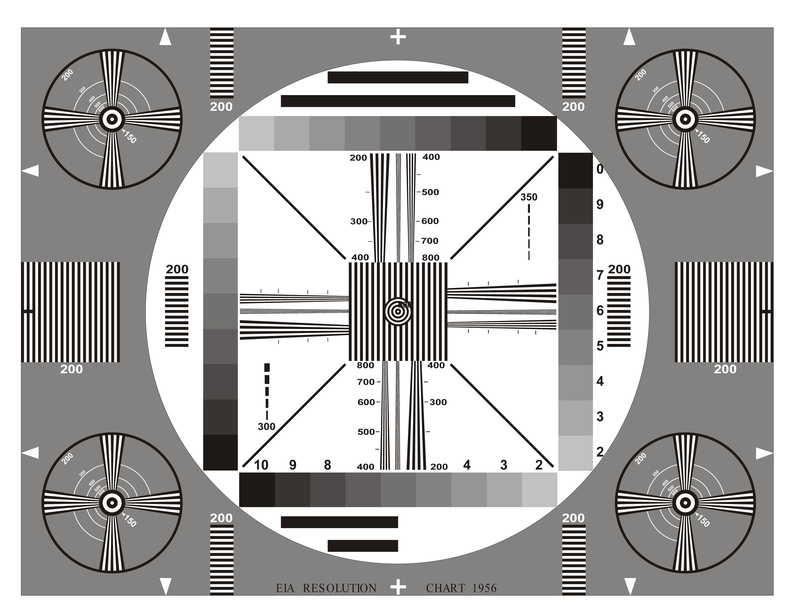
Resolution values in old reference books are provided for a fully opened diaphragm of the lens.
The lens resolution depends on energy distribution in the image of the point. Thus, it serves as a summary of different distortion elimination degree. But it is not the same as sharpness or image quality that depends on more factors.
Resolution value drops toward image border usually, that is why it is usually provided for center and for edge (or border). When you are stepping the lens down, resolution grows initially to some extent, but then it may drop again.
Resolution and sharpness are related concepts in photography and imaging, but they refer to different aspects of image quality. Here's a breakdown of the differences between resolution and sharpness:
Definition: Resolution is a measure of the level of detail that an imaging system can capture or display. It is often expressed in terms of pixels for digital images or line pairs per millimeter for optical systems.
Factors Influencing Resolution:
Definition: Sharpness refers to the clarity and distinctness of details in an image. It is a subjective perception of how well-defined and crisp the edges of objects appear.
Factors Influencing Sharpness:
Resolution: Important for tasks requiring detailed information, such as printing large images, cropping, or applications where fine details are critical (e.g., landscape photography).
Sharpness: Crucial for achieving visually appealing and well-defined images, especially in genres like portrait photography and macro photography.
In summary, resolution pertains to the amount of detail captured by an imaging system, while sharpness refers to the visual impression of clarity and well-defined edges. Achieving optimal image quality involves a combination of high resolution and sharpness, considering factors like lens quality, focusing accuracy, and post-processing techniques.


